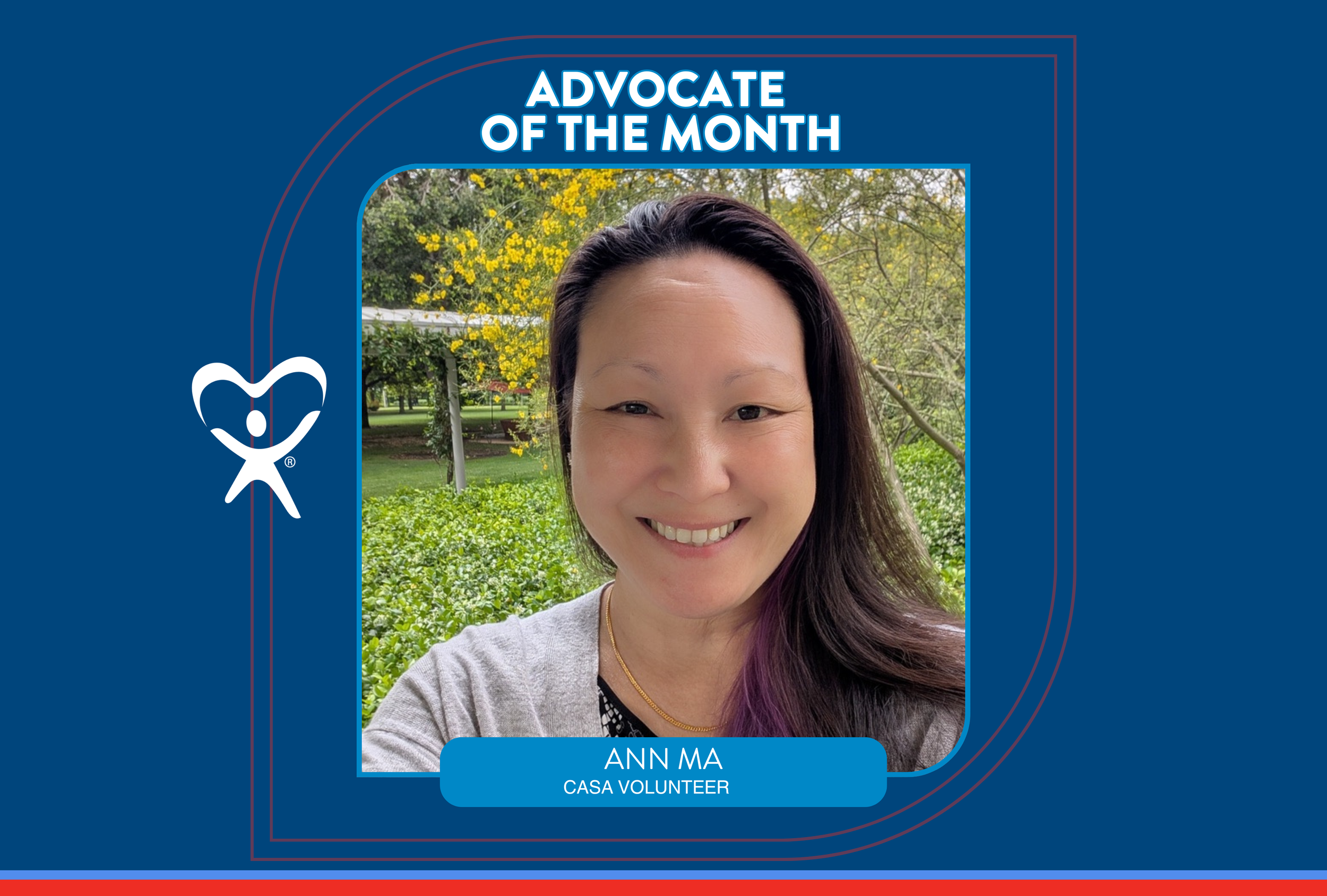
Volunteering as a CASA has its highs and lows and Ann Ma, who’s been a volunteer advocate with CASA OC for seventeen years, has seen both during that time. She starts a conversation about her time as an advocate by sharing, “It’s hard for me to tell you much about my current youth *Yolinda because she ran away a few months ago and I haven’t been able to reach her.”
Over the many years she’s been a CASA, Ann has been matched with several different youth. Her early matches were with younger children and, after those experiences, Ann requested a match with a teenager. “I felt I could have more impact in that age range and I hoped to build a meaningful relationship: help them get through school, the system and build a future. Plus my supervisor said teenagers have a harder time finding CASAs, everyone wants younger kids.”
Many of these matches have turned into a long term relationship. Even some that started off a bit bumpy. Ann explains, “Most of the kids I’ve worked with have grown into good adults, but in those early days, I’d hear, ‘I don't trust you, I don't want you, I don't need you here,’ so it can be hard when you’re in the moment.”
“But the reward has come after the fact. One of my early youth was not very trusting. We had a tumultuous relationship and she was often not truthful with me which made it hard for me to help her. It was often difficult to know what was and wasn’t really happening with her.”
“Years later, long after she’d gotten out of the system, she found me on Facebook and she's like, ‘Hey, do you remember me?’ So we met up for lunch and she said, ‘I was a total jerk to you the whole time you were a CASA. And I kept telling you I don't need you. I just want to let you know that you really did make an impact in my life and you really did help me a lot.’ And I'm still there for her now,” adds Ann.
Ann has been matched with her current youth *Yolinda for two years and during that time Yolinda has gone “AWOL” several times. Ann says, “As with many teenagers in the system, they can be easily influenced and manipulated, so we all hope that she’s safe wherever she is.”
Some of the children Ann has been matched with deal with the chaos in their lives by being quiet and withdrawn. Ann describes her second child as giving little more than yes or no answers during their first year and a half together.
Ann explains, “I tried many different tactics. I wrote restaurant choices on a piece of paper so she could just point and show me where she wanted to go. I found out she liked hiking, so for months, for every outing we went hiking.”
“I would pick her up and say, ‘This hike is four miles and there are places along the way we can turn around if you get tired, just let me know.’ Her way of letting me know she was done was to just turn around and start walking the other way. I’d be like, ‘OK, I guess we’re done for the day.’”
Then one day she ran away and, after a time, she got scared and Ann was the one who got the call. Ann says, “I answered my phone and she wouldn’t tell me where she was but we talked until her phone battery died.” Ann laughs and continues, “I didn't even know she had my phone number. I was really shocked when she called. I had heard so little of her voice that it took me a minute to even know who it was.”
The next day, the girl was found and returned to her group home. From that point on, she started opening up more and more with Ann. “It's just persistence, staying consistent, and sticking with it,” says Ann. “It can be frustrating, but you're getting through. They're just not going to show you. Sometimes it takes time for them to mature before they communicate more.”
Ann has also experienced the other extreme with some of her cases, “I've had teenagers that are like an open book on day one. They tell you all the bad things that've ever happened to them, willingly sharing all of their trauma.”
One of the things that consistently makes an impact with all of the youth she's worked with — The fact that Ann isn’t getting paid to be with them. “I introduce myself and tell them, ‘I don't get paid to do this, I’m here because I want to be here with you.’ That's always a big thing with these kids, especially the teenagers, because they know that most of the people in their lives are paid to be there.” She laughs when she shares the typical reaction from her youth, “Why would you do this? Don't you have anything else better to do with your time?”
Ann believes that her experience as an immigrant growing up in different countries helps inform her work as a CASA. “I grew up in Hong Kong and then we immigrated to Australia before moving to the United States when I was in the sixth grade. So although I didn’t experience abuse as a child, moving to different countries and to many different schools helps me understand how CASA youth often feel.”
With MBAs in both Finance and Management, Ann’s work life is in Enterprise Resilience with Capital Group where she assists with disaster planning across the globe for the company. She’s also responsible for monitoring during anything unforeseen ranging from natural disasters to cyber attacks.
She juggles her demanding job with her time volunteering as a CASA by warning her youth that she’s always on-call and may need to answer the phone. “Once we develop a relationship, I tell them I’m on-call 24/7 so there may be times I need to check in or monitor an event. Most of the time they're super interested, “What's going on? Ooh, there's a fire! Where's the fire? They see me on my phone, and some have asked, ‘How do you get a job like that? What do I need to do to get there?’”
Capital Group also supports Ann and the work of CASA by providing grants. Ann spearheads the efforts to apply for and direct the grants from the company for CASA. The company also hosts on-site CASA recruitment events for staff to attend.
“The more active CASA we have on staff, the more grant money I can apply for. I think we have ten active CASAs from our Orange County office as well as one team member on the CASA Board of Directors,” says Ann.
Ann explains how their community of advocates support one another at Capital Group, “We have our own CASA to CASA meet-ups about once a month. We eat lunch together and share our stories and challenges, and help each other out with suggestions on what has worked for each of us.”
The ongoing training provided by CASA has also been an asset for Ann. She says, “I do as much Continuing Education Training and find the webinars provided by MindSpring Mental Health very useful.” She adds, “If I get stuck on something in my case, I can always call my supervisor for help.”
Ann is supervised by Yazmin Mateo who had this to say about Ann, “Her current youth frequently absconds from care but Ann has remained incredibly patient and committed. She consistently follows up with the social worker, placement staff, and continues reaching out to Yolinda.”
Yazmin adds, “I think one of the most valuable things she provides is her consistency, so when Yolinda is ready, she knows Ann will be there. This case is a great example of how some of the most meaningful work CASAs do may not always have immediate, visible results. There's a real impact in staying consistent and never giving up on your youth. That steady presence can make all the difference when a youth is finally ready to accept support.”
Ann echoes this by saying one of the biggest lessons she’s learned as a CASA is patience. “Being a CASA for the past seventeen years has taught me a lot about patience which I honestly didn't have in my twenties when I started. My time as a CASA has also taught me to be open-minded and non-judgmental.”
After all of these years, Ann still remains connected with three of her youth. She even shares a matching tattoo with one of them. “We each have two small birds, I'm one bird, and she's the other one. When she moved out of state, that was the end of our CASA relationship, but we kept in touch, and I’ve travelled out of state to visit her a couple of times when she had each of her babies.”
Ann still finds herself mentoring this youth from afar, “She sends me pictures all the time, tells me how she's doing and I've been encouraging her to get her teacher credential.”
Despite the challenges she has faced with some of her youth, Ann remains deeply committed to CASA. “I would encourage advocates to stick with it - even when it can feel frustrating. Deep down, you're making a difference, and the kids do appreciate you. Sometimes it takes them growing into adults and maturing to understand the impact that you made in their lives when they were teenagers.”
If you are interested in becoming that steady presence in a child’s life, learn more by attending a CASA information session. Contact Norma Mendoza for upcoming dates.
*Name changed to preserve privacy