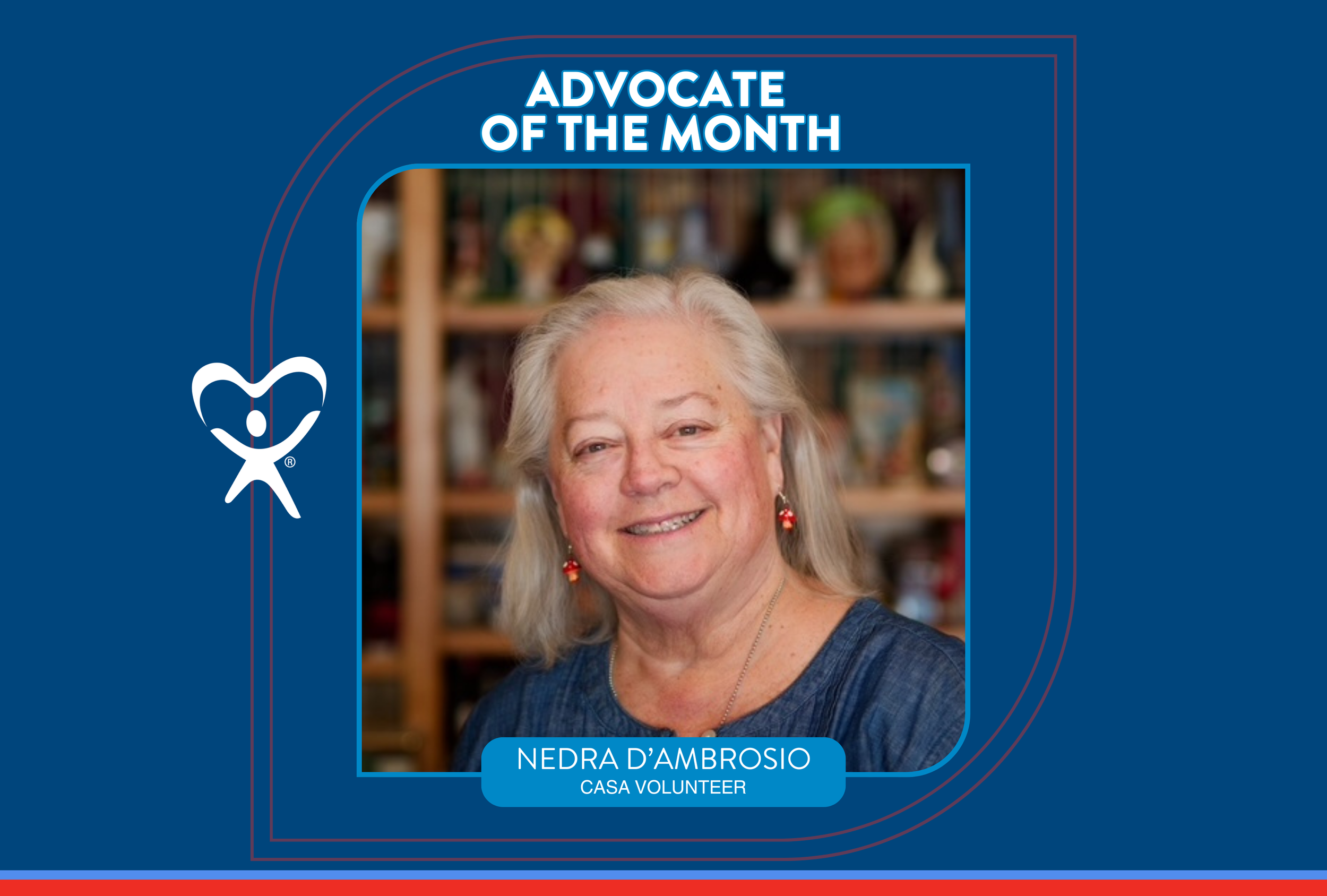
Nedra D’Ambrosio retired in 2020 after thirty-five years as an elementary school teacher. She says, “Teaching had been my whole life. I was married, had raised two boys who were now grown, and suddenly I had time—lots of it. I filled my days with knitting and reading, and before long I realized I had more yarn and books than I’d ever use over the course of my life expectancy.”
She first learned of CASA when scrolling Instagram one evening. “An ad popped up for CASA which I had never heard of before,” says Nedra. “And honestly, I was a little skeptical to see it on my social media feed - it sounded too good to be true. So I wrote the name down instead of clicking on it. The next day, I got on my computer and dug deeper. I was stunned. CASA has been around forever!”
Nedra decided to learn more, “I read everything and thought about it for a couple of weeks. Then I signed up for an information session. By the end of that meeting, I thought, ‘Oh. I can do this!’ So I signed up for the training and was sworn in. Within a week, I got a call from CASA asking if I’d take on twin girls in 11th grade!”
It took Nedra a moment to decide - she says, “I was a boy mom and had never taught beyond the sixth grade. And here they were asking me to work with two high school juniors – But I said yes.” She describes her first meeting with the two girls, “We went out to lunch, and almost immediately I realized I didn’t have to do much at all—because when you have siblings, they talk. They talked to each other, they talked over each other, they talked while they ate. That first meeting pulled me in. I knew right away, ‘this is for me!’”
The CASA training really prepared her for all kinds of potential situations according to Nedra but she said, she’s had a pretty easy time with the girls. “They were easygoing, kind, and polite—truly no trouble at all. And as I got to know them, their differences became clear. One was highly academic, involved in student government, and very driven. The other was very creative and loved creating art and learning about makeup, but was struggling in school.”
As an advocate, Nedra stepped in to see if she could assist her with making up lost credits at school. “I called the counselor and after verifying I had the proper credentials to be an educational advocate for my youth, the counselor met with me. Together we made a plan to help her succeed." Nedra continues, ”As the girls were entering 12th grade, the three of us went out to lunch, and she casually mentioned that she was all caught up on her credits. Then she added, ‘My counselor said I have a good chance of going to college.’ That moment still stays with me.”
“In January of their senior year, she had applied to several colleges. Every single one accepted her. That, to me, was the greatest success; both girls made it to college. They figured out grants and financial aid on their own. I didn’t do that part—but I was there,” shares Nedra. “Now they’re both halfway through their first year of college. One is at a Cal State school in Northern California, and we text regularly. The other is attending UCLA so I’ll drive up there to visit her and we go out to lunch and explore the area together.”
Then Nedra’s time with CASA took another turn, “In March of 2025, my CASA Advocate Supervisor, Yazmin Mateo contacted me and asked if I would also take on the twins' younger sister. She was fourteen at the time and in eighth grade. Suddenly I had three. What surprised me most was how different three siblings could be from one another. The older two were naturally polite and socially comfortable. The youngest struggled more.”
But Nedra has found ways to connect with the youngest through their shared love of crafting and reading. “She’s incredibly smart, wins academic awards, and is a talented visual artist. She paints, crochets, crafts—and teaches herself everything from YouTube. On one of our first outings, I gave her a large bag of yarn I wasn’t going to use anymore. Her eyes lit up. ‘For me?’ she asked. She crochets animals so well she could sell them.”
And as the two spend more time together, the two are feeling more and more connected. “With her, I’ve learned that patience, kindness, and praise matter more than correction. She walks with me now instead of bolting ahead and leaving me behind. She’s opened up quite a bit,” says Nedra..
Nedra says there are two lessons from her CASA training that have been the most helpful in her time as an advocate; the first is to show up early. She says, “I am always early. The girls never have to wonder if I’ll show up.” She laughs and says, “Sometimes I’m so early they’re still in bed, but that extra time gives me time to talk with their foster mom and listen to her concerns from an adult perspective.” She says the second lesson is to just listen. “That’s all I did in the beginning. I listened while the twins finished each other’s sentences. I learned who they were by not interrupting. Over time, our conversations became more two-sided as they began to ask me more about myself.”
Yazmin, Nedra’s Advocate Supervisor explains why she nominated her as Advocate of the Month, “Nedra is an exceptional CASA whose support has shaped the lives of three sisters. She was initially matched with the two older twins, and when the youngest asked if she could be her CASA too, Nedra immediately stepped up. After losing both parents, these sisters have relied on Nedra’s consistency, compassion, and belief in them. She advocates fiercely for them and has helped each girl believe in possibilities they didn’t think were attainable. With her encouragement, both twins were accepted into great colleges. Even with one now attending college up north, Nedra plans to visit soon, reflecting just how dedicated she remains to their journey.”
As she reflects on being an advocate for the three sisters Nedra says, “Now, having three youth feels manageable and meaningful. I text, visit and send care packages to the two at college and show up for the youngest who is still in high school. What I enjoy most is the trust they give me—the quiet moments when they share, and even the moments when they don’t need words at all. I can feel that I’m making a difference.”
To learn more about how you can help vulnerable youth in the foster care system waiting for a CASA match, please contact Norma Mendoza at CASA OC.