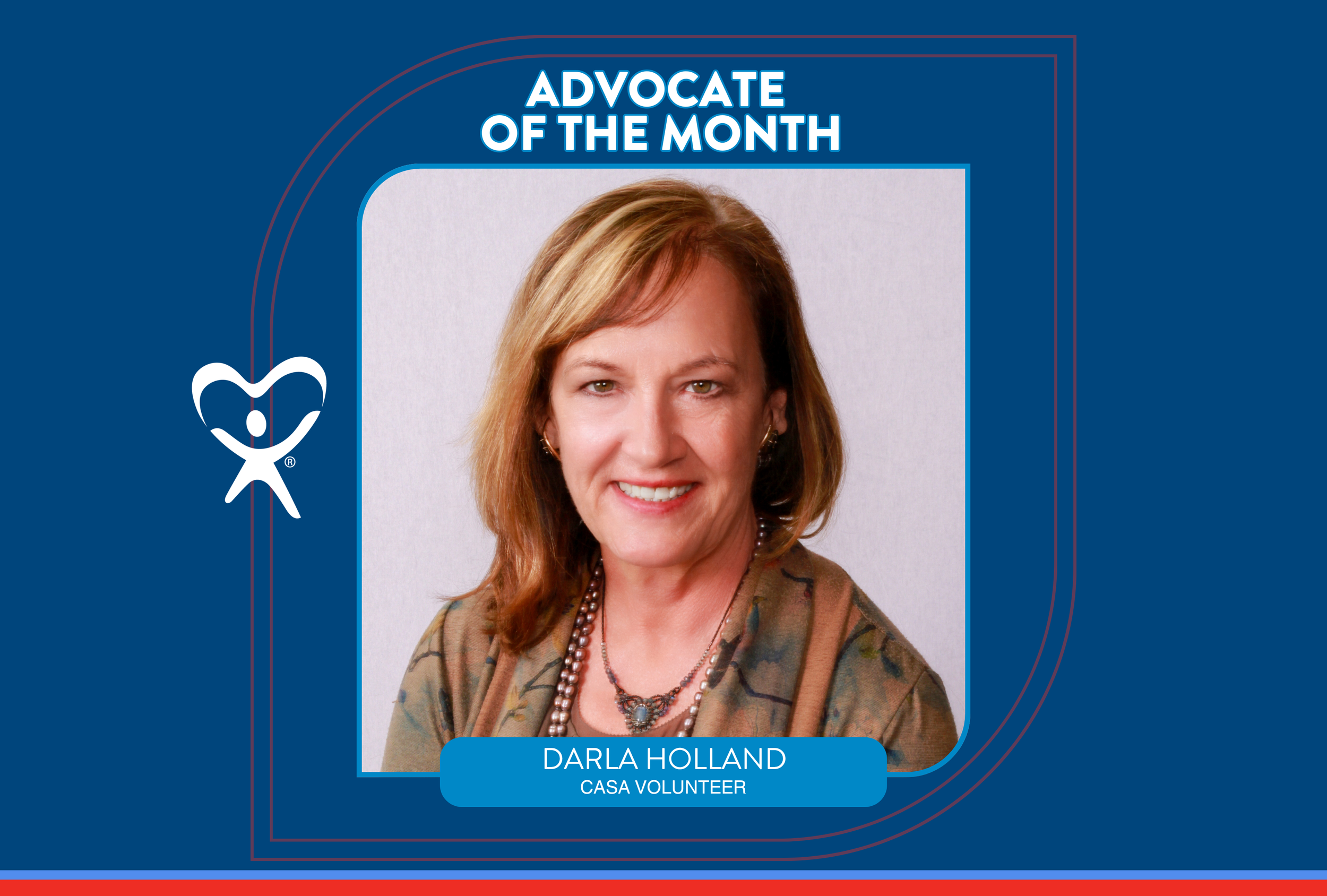
Since becoming an advocate with CASA Orange County five years ago, Darla Holland has been matched with two youth whose circumstances many would consider especially challenging. Her first youth, *Shawn faced complex medical issues and significant learning gaps caused by long absences from school. Her current youth is a 16-year-old boy undergoing cancer treatment while navigating difficult family circumstances.
Yet when asked how she manages such difficult cases, Darla seems surprised by the question. “I don’t view these cases as challenging at all,” she says. A physician with Kaiser Permanente Medical Group for 35 years, Darla was comfortable navigating medical complexities. What required a greater adjustment was reorienting her approach in building a relationship with her CASA youth.
“In medicine, things happen quickly. You identify a problem and work toward a solution,” she explains. “As a CASA, the timelines are very different. My problem-solving skills are helpful, but I’ve learned there can be no expectation beyond just showing up.” That simple commitment—showing up consistently—became the foundation of her relationship with Shawn.
Over the five years Darla was his CASA, Shawn experienced constant change. Social workers, placements, schools, and attorneys came and went. Darla remained the one constant. “Shawn had seven social workers in five years,” she recalls. “His placements changed, schools changed, lawyers changed, but I just kept showing up.”
Sometimes, Shawn tested that commitment. “He would go through entire outings without saying a word, just to see if I’d come back,” Darla says. “I learned that something significant doesn’t have to happen every time I see him. Building trust takes time. That patience paid off. Today, even after Shawn’s case has closed, the two remain close. “It’s been a wonderful experience,” Darla says. “I’ve learned so much from him.”
According to Darla’s Advocate Supervisor, Cindy Nydell, that ability to meet her youth where they’re at is what makes Darla such an exceptional advocate. “Darla had an amazing connection with Shawn,” says Cindy. “She was proactive about his health needs, attended all of his IEP meetings, and made sure he had the support he needed. Even though he’s now 21 and his case has closed, they still stay in touch. She recently was matched with a new youth and is already building a strong connection with that teen as well.”
CASA’s HELP Model—Health, Education, Life Skills, and Permanency—has provided Darla with a useful framework for her advocacy work. But she admits that one area initially required more intentional focus than others. “While most advocates naturally think about Health, Education, and Life Skills, I found it easy to overlook the Permanency piece,” she says. “The HELP Model reminds me to step back and remember the larger system—the judges, social workers, and attorneys—and how each person plays a role in the youth’s life.”
During her time with Shawn, Darla’s advocacy spanned both Health and Education in deeply practical ways. She helped him learn to navigate the medical system and encouraged him to take an active role in his own care. “I helped Shawn learn how to advocate for himself medically and worked with him on medication compliance,” she says. “However, I’m very mindful of staying in my lane—I’m his CASA, not his doctor—but my medical background was helpful, especially during the transition from pediatric to adult care.”
That transition is often difficult for any young adult with complex medical needs. For youth in the dependency system, it can be even more challenging. “Up until they’re 18, foster parents help them navigate these things,” Darla explains. “Once they turn 18, they’re on their own. I was able to use some of my medical connections to help Shawn manage the transition of his medical care.”
Education was another area where steady advocacy made a lasting difference. Shawn’s Individualized Education Program (IEP) opened doors to additional support services, including transition programs and disability resources as he moved toward community college.
One moment stands out for Darla. “At an IEP meeting, Shawn’s English teacher insisted he remain in a general education class,” she recalls. “His teacher said he participated meaningfully and belonged there. It changed how Shawn saw himself. It demonstrated the power of a teacher saying, ‘You can do this!’”
Shawn ultimately graduated from both high school and college and Darla was there for both ceremonies. “He was surprised I would take the time to be there,” she says. “Now he feels like a friend I’ve known for a long time.”
Darla reflects on what fuels her passion for CASA. “I’ve dealt with difficult cases my whole professional life as an internist,” she says. “The heartbreak of family issues, aging parents, dementia and devastating diagnoses. CASA youth face significant challenges too—but they are on the uphill side of life. Knowing a young person had no one in their corner—and now they do, and that person is me, is very rewarding.”
When her time with Shawn ended, Darla immediately expressed interest in continuing her CASA work. She was especially drawn to youth in the juvenile justice system after attending a CASA training session on Youth Justice cases. She explains, “I attended a training led by Amy Crowley, CASA’s Collaborative Courts Manager, and was blown away. I hoped I could move in that direction with my next CASA assignment.”
When it was time for her next CASA match, she was presented with two different cases; a teenage girl in juvenile hall, or a 16-year-old boy undergoing cancer treatment while facing significant family challenges at home.
“I was concerned that in our flawed healthcare system, this very ill child might not receive timely care,” she says. “I felt he needed someone who could advocate for him if necessary and I knew I could do that.” She has now been matched with her new youth since March.
Darla says her motivation to serve goes back to her family. “A lot of people helped me along the way,” she says. “I won the birth lottery with my family, and I’ve always felt a responsibility to give back. Teachers, mentors—people opened doors for me that I didn’t even know existed.”
That sense of gratitude continues to shape her commitment to the CASA youth she serves. At the center of her approach is a simple principle: showing up, again and again, without expectation.
If you are interested in becoming that steady presence in a child’s life, learn more by attending a CASA information session. Contact Norma Mendoza for upcoming dates.
*Name changed to preserve privacy